


Views: 0 Author: Site Editor Publish Time: 2026-08-28 Origin: Site


Transitioning from standard white or gray core to a specialized dark core elevates the aesthetic of signage, mounting, and premium presentations. It introduces specific procurement risks. You cannot treat these substrates like everyday commodity foam boards. Purchasing substandard materials often leads to crushed edges during fabrication. They may suffer severe delamination in humid environments. You risk costly reprints and wasted labor when tolerances fail on the production floor.
We see frequent failures when buyers misunderstand the physical properties of these substrates. A dense core requires careful handling. A weak core collapses under modern flatbed printer vacuums. You must align your material choice directly against your exact processing methods.
This guide outlines the exact technical specifications, processing tolerances, and vetting criteria you need. We provide the framework required to make a confident, scalable purchasing decision. You will learn how to avoid warping, verify core density, and establish strict standards for your vendors.
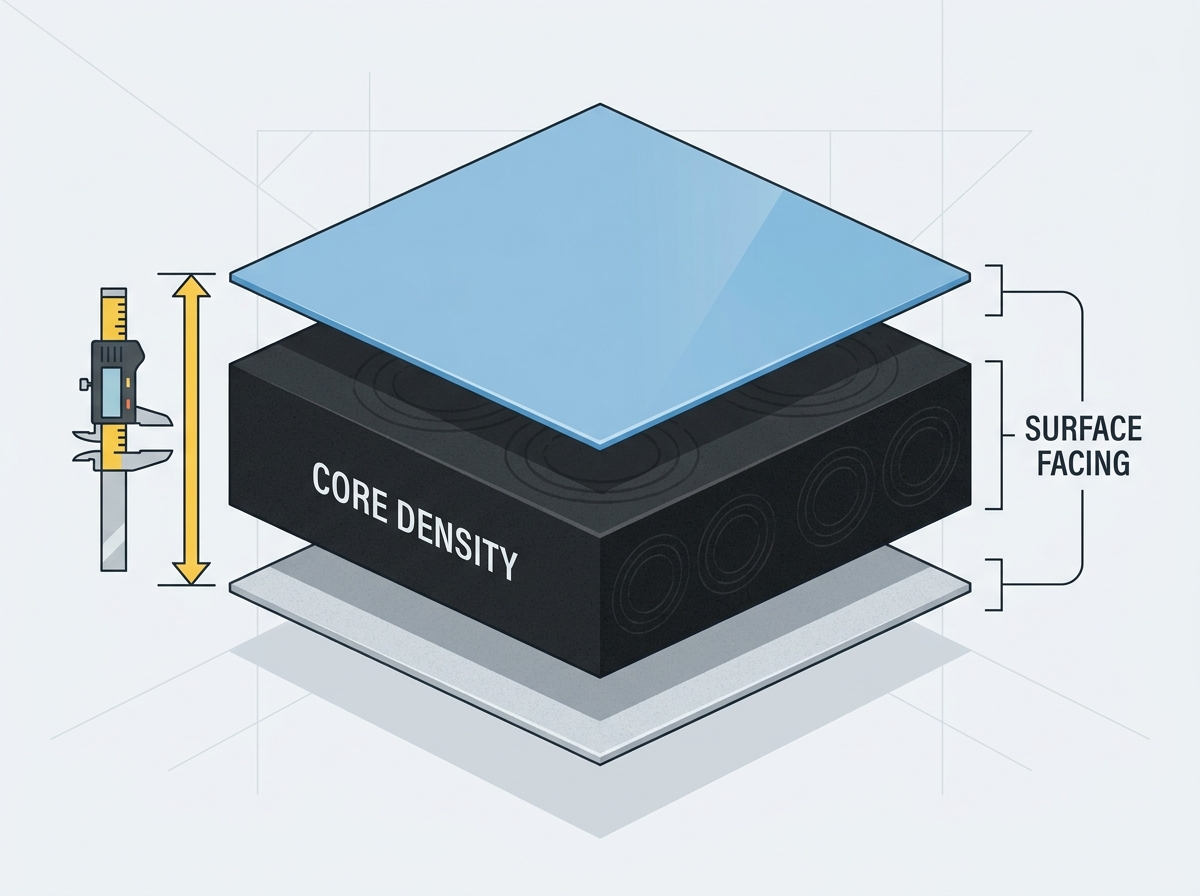
Core Density Dictates Durability: Evaluate GSM (Grams per Square Meter) to ensure the board resists edge-crushing during CNC routing or die-cutting.
Facing Material Must Match Application: Differentiate between paper-faced, polystyrene-faced, and PVC-faced boards based on adhesive and printing requirements.
Tolerance Consistency: Strict thickness and flatness tolerances are non-negotiable to protect flatbed printer heads and ensure seamless mounting.
Vetting is Critical: A reliable black core board supplier must provide batch-to-batch consistency and robust freight packaging to prevent corner damage.
Standard foam-centered materials often leave a bright white line around the perimeter of a finished graphic. This forces fabricators into secondary finishing steps. You must either apply edge-banding or manually paint the exposed sides. These manual processes destroy margins and slow down throughput.
Specifying a dark, solid core ensures aesthetic continuity. Premium retail signage requires a flawless finish. Gallery mounting demands invisible edges. Eliminating exposed light-colored edges instantly upgrades the perceived value of the final display. You skip the secondary finishing entirely.
Light blocking, or opacity, represents another primary business case. Double-sided printing fails when light transmits through the substrate. Shadows from one side bleed through to the other. High-glare retail environments also demand zero light transmission. A dense, pigmented core blocks ambient light completely. It preserves the color accuracy of your UV-cured inks.
To establish clear success criteria, you must align the material rigidity and surface tension against the specific lifespan of your project. A short-term trade show graphic requires less structural permanence than a long-term museum display. Selecting the right black core board ensures your substrate survives its intended lifecycle.
Density serves as the foundation of board performance. You must define the minimum density required to prevent structural warping. Applied vinyl films and heavy UV inks exert surface tension. A weak core bows under this uneven stress.
Assess the material recovery rate. We call this "memory". It measures how well the internal foam rebounds after brief compression. Pinch rollers on large format printers squeeze the board. Cold-roll laminators apply significant downward force. High-memory cores bounce back to their original caliper. Low-quality alternatives remain permanently crushed, leaving visible divots across the printed graphic.
The facing material dictates adhesion, printability, and environmental resistance. You must choose carefully.
Paper-Faced: This remains highly cost-effective. It works best for indoor, short-term mounting. Custom framing applications frequently rely on it. However, it absorbs ambient moisture quickly.
Plastic/Polystyrene-Faced: These facers resist moisture intrusion. They provide a smooth, closed-cell surface ideal for direct UV flatbed printing. They withstand moderate handling.
Adhesive Compatibility: You must verify the surface tension. Industry standards measure this in dyne levels. Ensure a dyne level above 38 for optimal ink and adhesive wetting. High-tack adhesives applied to low-dyne surfaces cause immediate delamination.
Surface Facing Comparison Chart
Facing Material | Moisture Resistance | Primary Application | Ideal Dyne Level |
|---|---|---|---|
Paper | Low | Indoor mounting, framing | N/A (Porous) |
Polystyrene | High | UV direct printing | > 38 Dynes |
PVC | Very High | Rigid signage, fabrication | > 40 Dynes |
Thickness variance ruins flatbed printer setups. You must demand strict tolerances from your vendor. Detail acceptable variances in your purchasing agreements. For a standard 5mm board, you should accept no more than ±0.1mm variation. Inconsistent thickness leads to catastrophic head strikes. Printer carriages moving at high speeds will crash into thick spots, destroying expensive printheads.
Squareness determines your labor costs. Out-of-square boards require immediate manual trimming before printing. This increases labor costs heavily. It creates excessive material waste. Always specify factory-squared edges in your procurement documents.
Foam-centered materials carry physical realities you cannot ignore. They react to their environment.
The moisture trap remains the primary cause of bowing. Paper facers absorb humidity unevenly. If the face absorbs more moisture than the back, the board cups. You must acknowledge these hygroscopic properties. Lamination seals one side. The unsealed side continues absorbing moisture. This uneven barrier guarantees eventual warping in humid spaces.
Temperature sensitivity introduces thermal expansion risks. Every substrate features a specific coefficient of thermal expansion. Heat causes the plastic or foam molecules to expand. Boards placed in window displays face intense, direct sunlight. They absorb massive amounts of solar radiation due to their dark color. You must specify heat-resistant facings for these specific environments to prevent ugly surface bubbling.
Storage requirements dictate your pre-production success. You must establish strict baseline warehouse conditions. Neglecting storage ruins perfectly good inventory.
Maintain a climate-controlled environment. Aim for 20-25°C.
Keep relative humidity stable between 40% and 60%.
Enforce flat, horizontal storage on pallets. Never lean boards vertically against walls.
Allow substrates to acclimate to the print room environment for 24 hours before processing.
Fabrication methods expose the true quality of your substrate. Clean edge cutting requires a high-density cellular structure.
Compare how different densities respond to shop equipment. Guillotine cutting demands a firm core to prevent edge-crushing. CNC routing requires specific spindle speeds and sharp up-cut bits. Digital oscillating knives perform beautifully on high-quality foam. Conversely, a low-quality core will tear. It pills up, leaving ragged edges. Poor density results in a messy, unprofessional finish.
Ink adhesion heavily impacts UV and screen printing. Plastic facings naturally generate static electricity during transit and handling. Static repels ink droplets. This causes overspray and fuzzy text. You must address the necessity of static-free surfaces. Implement anti-static bars or manual alcohol wipes. Furthermore, some demanding applications require specialized chemical primers. Primer ensures the UV ink crosslinks aggressively directly to the substrate.
Mounting pressure ruins inexperienced fabricators. Cold-roll laminators exert heavy pneumatic pressure. You need strict guidelines for operators. Too much pressure crushes the foam structure permanently. Too little pressure leaves air bubbles. You must calibrate the nip pressure precisely. This ensures edge-to-edge adhesion while preserving the internal cellular geometry.
You cannot scale production without reliable vendor partners. Vetting them properly saves thousands of dollars in wasted materials.
Batch-to-batch consistency separates amateurs from professionals. You must know how to request and test samples. The black pigment must remain absolutely uniform across different production runs. Cheaper manufacturing processes yield gray or charcoal variations over time. Request samples from three different chronological batches. Compare them visually under D50 daylight lamps.
Freight and packaging standards require heavy scrutiny. Foam boards remain highly susceptible to transit damage. Forklifts and careless shipping lanes destroy pallet corners easily. You should evaluate a black core board supplier based strictly on their palletizing methods. Demand reinforced edge protectors. Ensure they use robust shrink-wrapping protocols. A supplier skimping on packaging will cost you dearly in freight claims.
MOQ (Minimum Order Quantity) and lead times impact your cash flow. You must align supplier production capabilities directly against your inventory turnover rate. Excessively high MOQs tie up operational capital. Conversely, long ocean lead times risk project delays. Negotiate terms allowing for just-in-time (JIT) deliveries where possible.
Check for strict certifications. Archival framing requires acid-free designations to prevent artwork degradation. European markets demand RoHS compliance. Verify localized environmental safety standards before placing bulk orders. Legitimate vendors proudly display these testing certificates upon request.
Sourcing the right black core board requires looking past the color and focusing on core density, dimensional stability, and fabrication compatibility. You must align the facing material to your print method. You must enforce strict climate controls to prevent warping.
Start shortlisting vendors immediately. Request technical specification sheets (TDS). Ask for A4 or A3 testing samples from at least three vendors. Compare their density, thickness variance, and surface dyne levels side-by-side.
Finally, conduct a thorough pilot run. Utilize your specific cutting equipment and flatbed printers. Test the ink adhesion and edge routing yourself before committing to a full pallet or container load.
A: The core itself is usually water-resistant if made of polystyrene or PVC, but paper-faced varieties are highly vulnerable to moisture. Always match the facing to the environment. Choose solid plastic facings for areas prone to humidity.
A: Warping typically occurs due to uneven surface tension (e.g., laminating only one side) or drastic changes in environmental humidity post-production. The unsealed side absorbs moisture and expands, causing the panel to bow toward the laminated side.
A: Standard foam-centered boards are recommended for indoor use. For outdoor applications, solid black PVC or aluminum composite materials (ACM) are structurally superior and weather-resistant. Foam cores degrade quickly under direct UV and rain exposure.
A: 5mm (3/16") is the industry standard for general signage and mounting, while 10mm (3/8") is preferred for freestanding or oversized displays requiring higher rigidity. Thicker boards resist bowing better in large format retail installations.


