


Views: 0 Author: Site Editor Publish Time: 2026-07-27 Origin: Site


Selecting the wrong rigid substrate can ruin a project quickly. It leads to compromised print quality. You might also face unexpected structural failure. Poor choices frequently inflate overall project costs unnecessarily. Both regular and multi-layered boards dominate the display industry today. Yet, their structural compositions differ greatly. This internal structure dictates distinct performance outcomes. It affects rigidity, opacity, and daily machining operations. Our goal is to strip away vague marketing claims. We will objectively compare these two popular substrates. You will get a clear framework for specifying materials. This helps you match the exact application and durability requirements. It also keeps your budget on track.
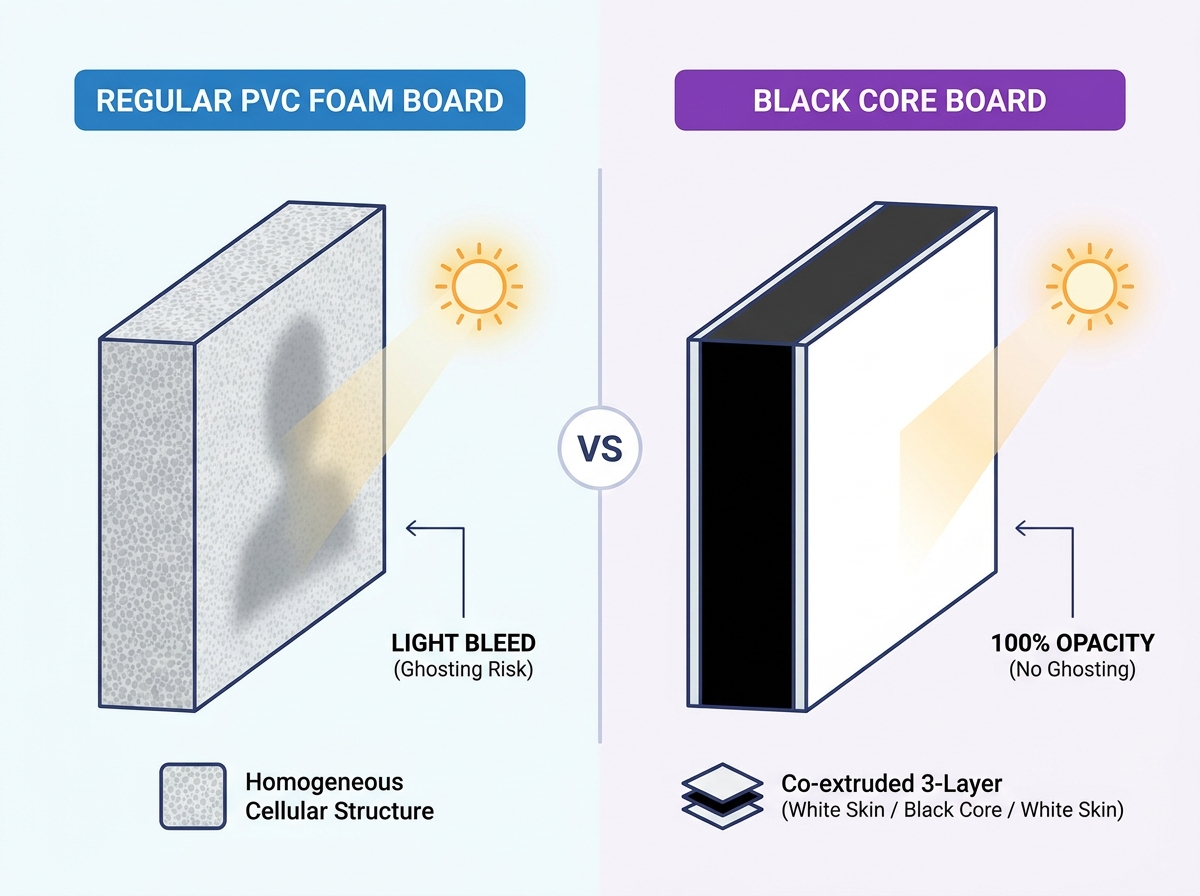
Composition: Regular PVC foam board is a homogeneous, solid-color cellular structure; black core board utilizes a co-extruded manufacturing process featuring a dense, light-blocking core sandwiched between bright white outer skins.
Opacity: Black core board delivers 100% block-out performance, making it the superior choice for double-sided printing without image ghosting.
Rigidity: The dense inner layer of black core board offers enhanced dimensional stability and higher bending strength compared to standard PVC foam board.
Cost-to-Value: Regular PVC foam board is highly cost-effective for single-sided or short-term indoor applications, whereas black core boards justify their price point in premium, structural, or demanding outdoor environments.
Understanding how factories produce these materials reveals why they behave so differently in the field. The manufacturing process directly alters the physical properties of each board.
Manufacturers typically use free-foam or Celuka extrusion processes for standard boards. These methods create a uniform, closed-cell structure. The material remains consistent from the surface all the way through the core. You will notice identical color and density throughout the entire cross-section. This homogenous nature provides predictable cutting behavior. However, it limits the structural strength of the sheet. When you specify a standard PVC foam board, you get a highly versatile but structurally basic product.
Advanced substrates require a completely different approach. Manufacturers build them using a multi-layer co-extrusion process. This sophisticated method combines distinct layers into one cohesive sheet during extrusion. Bright, highly receptive white skins form the outer layers. These sit firmly over a rigid, high-density dark core. Factories often use recycled materials for this inner layer to improve sustainability. Engineers designed this specific sandwich structure for two reasons. First, they wanted to manipulate light transmission. Second, they needed to increase overall structural yield. The resulting board behaves much like an I-beam, offering superior strength.
We must evaluate these substrates based on actual physical demands. Optic performance and structural integrity play massive roles in final project success.
Light bleed causes severe issues for retail graphics. Standard homogeneous boards remain highly susceptible to light penetration. Direct overhead lighting or bright sunlight passes through the material easily. If you print graphics on both sides, this light causes visual interference. Industry professionals call this "ghosting." The back image blurs into the front image.
Conversely, the dark core acts as a complete light barrier. It stops all light transmission instantly. This ensures high-contrast, independent graphics on both sides. You never have to worry about environmental lighting conditions ruining the display. A premium black core board guarantees absolute opacity for critical retail environments.
Standard boards offer great flexibility. They remain lightweight and easy to handle. However, they lack inherent stiffness. They remain prone to slight warping over large, unsupported spans. Varying temperatures exacerbate this bending issue.
The dense inner layer of a co-extruded board drastically increases stiffness. It improves the flexural modulus of the sheet. You can use it across wider spans without sagging. This reduces the need for extensive structural framing. Large-format displays look cleaner and require less background support hardware.
You must address the physical trade-offs of increased density. The enhanced rigidity introduces a slightly higher overall sheet weight. This heavier mass impacts several logistical factors. Shipping calculations will increase slightly. Installation crews must handle the extra weight safely. You should calculate these weight variations before planning mounting hardware or suspension cables.
Property Metric | Standard Cellular Board | Co-Extruded Sandwich Board |
|---|---|---|
Core Structure | Homogeneous | Multi-layered |
Light Opacity | Low to Medium | 100% Block-out |
Flexural Rigidity | Flexible | Highly Stiff |
Edge Appearance | Solid Color | Striped / Two-Tone |
Relative Weight | Lighter | Heavier |
Theoretical properties matter, but shop-floor realities dictate production schedules. You must understand how these materials react to standard fabrication tools.
Both boards offer excellent surface tension. They readily accept UV-curable, latex, and screen printing inks. The white skins provide a brilliant canvas for high-resolution graphics.
We must check a common assumption here. The surface print quality is virtually identical between both options. The true difference lies strictly below the surface. The dark core impacts localized curing temperatures slightly. It also eliminates light interference during UV curing. This results in sharper contrasts for double-sided prints.
Machining these substrates requires distinct approaches.
Standard Cutting: Regular boards cut easily. Standard blades and basic routers glide through the uniform density. The edge color matches the surface flawlessly. This provides a seamless look without any need for edge-capping.
Precision Routing: Multi-layered boards require precision router bits. The varying densities between the skin and core can cause tool chatter. You should use sharp O-flute bits for clean results.
Aesthetic Risk Management: The exposed dark edge remains highly visible after cutting. You must factor this physical stripe into your design. Designers can utilize it as a premium visual accent. Alternatively, fabricators must conceal it via edge-banding.
Choosing the correct material prevents costly remakes. Match the substrate strictly to your environmental demands and design goals.
Standard boards excel in specific scenarios. You should specify them when facing the following conditions:
Single-sided wall-mounted graphics where light bleed does not matter.
Interior wayfinding signs mounted flush against solid surfaces.
Short-to-medium term promotional displays needing quick turnaround.
Applications requiring intricate, seamless 3D routing. A uniform edge color remains mandatory for these complex shapes.
Budget-constrained projects requiring high volume and minimal weight.
Premium multi-layered boards solve complex structural challenges. Specify them under these exact conditions:
Free-standing retail displays like endcaps and aisle signs. These require graphics on both sides without visual interference.
Outdoor signage subjected to direct sunlight. Light-blocking becomes absolutely critical here.
Structural applications requiring maximum rigidity. You can achieve stiffness without upgrading to heavy aluminum composite materials.
Premium presentations where designers desire the exposed dark edge as an architectural element.
Procurement teams must look beyond initial invoice prices. A holistic view of material lifespan reveals the true value of each substrate.
Expect a moderate price premium for co-extruded boards. The complex manufacturing process simply costs more to run. Factories use more resin and require highly calibrated extrusion dies. Standard homogeneous boards will always win on pure upfront sheet cost. They remain the undisputed champion for tight budgets.
However, you must calculate the hidden labor savings. Think about traditional double-sided signage. Fabricators often print two separate standard sheets. They then mount them back-to-back using adhesives. This prevents light bleed but doubles material usage. It also doubles printing time and increases labor significantly.
A single co-extruded sheet eliminates this entire process. You print directly on both sides. This drastic reduction in labor often negates the higher upfront sheet price. Furthermore, you should assess durability. The stiffer core resists warping under heat. Your signs stay flat longer. You reduce replacement cycles and maintenance visits. This lifecycle durability creates massive value for permanent retail fixtures.
Do not order blindly. Request detailed spec sheets from your supplier. Ask for physical samples of both materials. Perform in-house test cuts using your specific CNC routers. Run test prints to verify ink adhesion and color accuracy. Validate these physical properties before committing to high-volume procurement.
Your baseline decision relies on application physics. Choose standard homogeneous boards for single-sided, budget-conscious projects. They deliver excellent printability and easy machining. However, you should upgrade immediately when project demands increase. Stiff, multi-layered boards solve complex light transmission problems effortlessly. They eliminate ghosting entirely. Their enhanced flexural strength reduces framing needs. Make the switch when structural rigidity, perfect opacity, and double-sided print performance become non-negotiable criteria for your project.
A: Yes, it performs well outdoors. The bright white skins contain specific UV inhibitors to prevent rapid yellowing. Furthermore, the dense inner core resists thermal expansion better than standard boards. However, extreme, prolonged sun exposure will eventually degrade any plastic. Always seal edges in wet environments.
A: No special equipment is necessary. Standard CNC routers and heavy-duty cutters work perfectly. However, you should use optimal bit types. Single-edge O-flute bits handle the multi-density transition best. This ensures clean cuts without tearing the white outer skins.
A: No, it does not. The bright white skins provide the exact same white point as regular boards. Your RIP software requires no special color profiling. The dark core simply stops light transmission from the rear, ensuring your colors remain punchy and accurate.
A: Recycling realities vary locally. Standard boards often recycle cleanly where facilities accept rigid plastics. Co-extruded boards are technically recyclable, but the varying densities complicate the process. Always check local facility guidelines regarding multi-layered plastics before disposing of large volumes.


