


Views: 0 Author: Site Editor Publish Time: 2026-07-17 Origin: Site


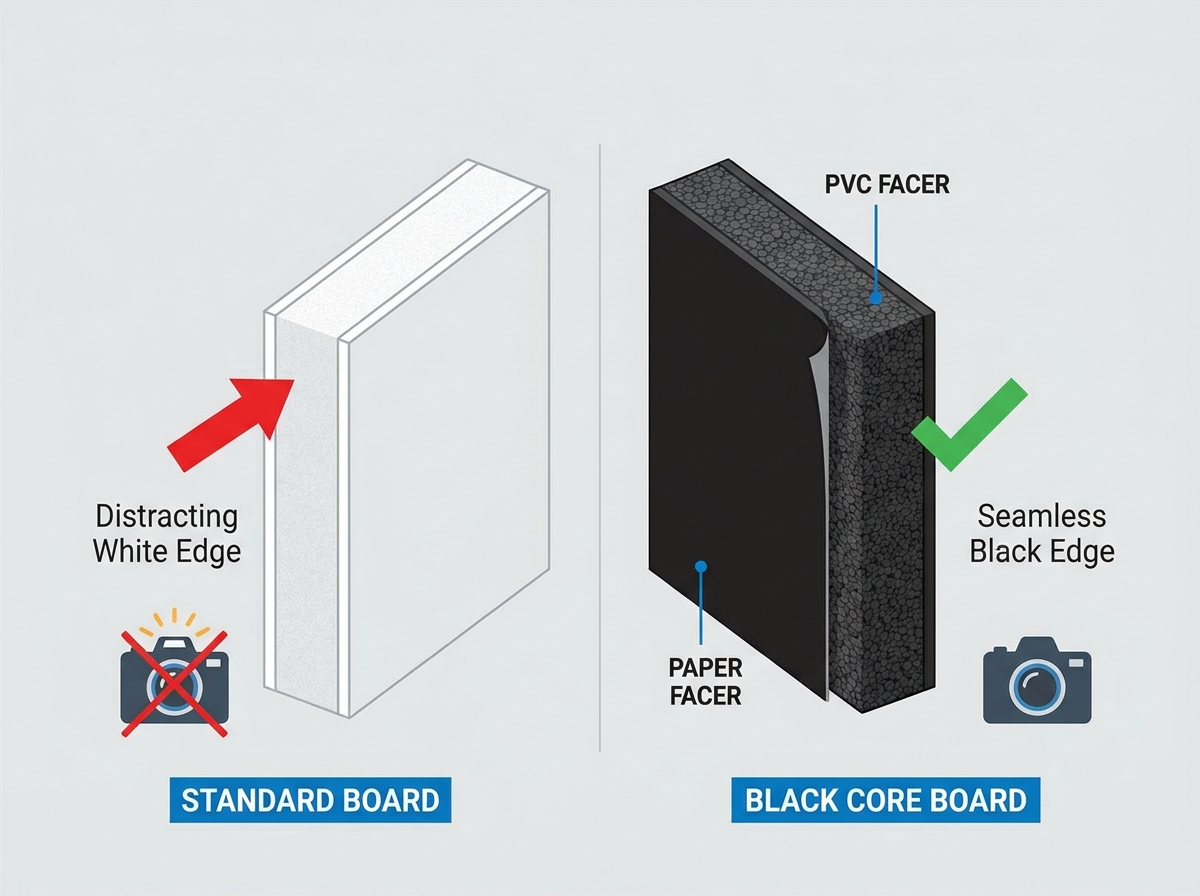
Standard display materials often ruin premium visual presentations. Exposed white edges create distracting borders around high-end graphics. A black core board solves this exact problem effectively. Manufacturers design this rigid display substrate to eliminate those stark borders completely. They dye the inner material during the initial manufacturing process. Upgrading to dark-core materials represents a strategic business decision. Designers must balance strict aesthetic requirements against project budget constraints. They also require specific light opacity levels for professional mounting and signage. You face numerous choices when sourcing display materials today. This article outlines the essential structural realities of these boards. We evaluate popular material variations, including both foam and rigid PVC options. You will gain a clear, practical framework. It helps you specify the correct substrate for any commercial application.
Visual Continuity: Black core boards eliminate the need for edge-banding or painting, providing a clean, seamless look for gallery and retail environments.
Material Diversity: Options range from lightweight paper-faced foam to durable black core PVC board, each serving distinct longevity and fabrication requirements.
Performance Trade-offs: While offering superior aesthetics and light-blocking (opacity), black core variants typically carry a price premium and may require specific cutting tools to prevent edge fraying.
Decision Driver: Material selection should be dictated by the intended lifespan of the project, environmental conditions (humidity/temperature), and the fabrication method (manual vs. CNC).
You must understand the underlying anatomy to select the right material. Extrusion dictates the core quality. The interior consists of either extruded polystyrene or expanded PVC. Factories dye this mixture black during the initial melting phase. This deep-dyeing process ensures consistent color throughout the entire substrate thickness. You will never see a white center when you cut into it.
The outer layers serve as the printable surface. Industry professionals call them facers. Manufacturers bond these facers directly to the dark inner material. You will typically encounter three main facer types:
Paper Facers: These serve as the standard option for short-term presentations. They handle basic mounting tasks well but offer minimal moisture resistance.
Plastic/PVC Facers: Factories use these to create rigid, weather-resistant structures. They repel moisture effectively and provide excellent structural rigidity.
Wood-Fiber Veneers: Heavy-duty variants utilize these ultra-rigid layers. They deliver maximum warp resistance for permanent installations.
The bonding process matters just as much as the materials. Factories use industrial adhesives and heat lamination to secure the layers. Delamination represents a major risk during production. Poor bonding causes the outer layers to peel away from the center. You must evaluate delamination resistance as a primary quality-control metric.
Standard white materials dominate the market. When should you specify a dark variant instead? Visual presentation drives the majority of these decisions. A dark edge eliminates the notorious "white line" distraction. High-end photography mounting demands this seamless look. Premium retail point-of-purchase displays also require flawless, unobtrusive edges. Dark-themed exhibits benefit heavily from this continuous aesthetic.
Light opacity offers another massive operational advantage. Dark inner layers naturally absorb ambient and direct light. Standard white substrates often fail here. They let backlight show right through the graphic. This creates washed-out visuals on double-sided suspended signs. A dark center completely blocks light transmission. You maintain crisp, vibrant graphics in bright window displays.
You must also evaluate the durability versus weight matrix. Substrates need a high strength-to-weight ratio to function properly. A dark-centered panel maintains a lightweight profile. Installers can handle large sheets easily. Yet, the material offers sufficient rigidity for medium-to-large formats. The boards will not sag under their own weight when hung from ceilings.
You have three primary material categories to choose from. Standard foam works well for basic needs. Expanded plastic serves demanding retail environments. Heavy-duty variants tackle permanent structural installations. Understanding these differences prevents costly material failures.
This category dominates the entry-level market. It works best for short-term presentations and indoor mood boards. Designers frequently use it for lightweight hanging signs. However, the material has distinct limitations. The structure dents quite easily upon impact. It suffers irreversible moisture damage if exposed to high humidity. Manual cutting often causes severe edge crushing.
This material delivers superior commercial performance. It works best for mid-to-long-term retail displays. You can confidently place them in high-traffic public areas. They handle direct UV flatbed printing beautifully. The advantages are substantial. A black core PVC board is highly durable and dent-resistant. It repels moisture perfectly. The dense structure remains sound during CNC routing.
Professionals specify these for permanent exhibits. They work perfectly for large un-framed photo mounting. They utilize rigid resin or wood-fiber facers. This construction provides exceptional warp resistance. They handle aggressive environmental shifts without bending.
Use the comparison chart below to guide your material selection process.
Material Category | Best Use Case | Durability Level | Routing Capability |
|---|---|---|---|
Standard Foam Core | Short-term presentations | Low (Dents easily) | Poor (Prone to tearing) |
Expanded PVC | High-traffic retail signage | High (Moisture resistant) | Excellent (Clean cuts) |
Heavy-Duty Variants | Permanent museum exhibits | Maximum (Warp resistant) | Good (Requires special blades) |
Professional environments demand flawless execution. Shoddy edges ruin expensive graphics instantly. We see these premium boards driving returns across four specific commercial sectors.
Fine Art & Photography Mounting: Galleries require an unobtrusive backing material. Dark edges blend perfectly into museum shadows. They disappear seamlessly inside dark gallery frames. The artwork remains the absolute focus of the viewer.
Retail & Point-of-Purchase (POP) Displays: Retail brands want dimension and depth in their signage. Cheap-looking white edges ruin premium branding efforts. Dark edges elevate the perceived value of the entire display.
Architectural & Prototype Modeling: Architects build complex massing models frequently. They need crisp, clean lines to convey scale. Dark substrates simulate real building materials accurately. They give structural models a professional, polished finish.
Trade Show Exhibits: Booth builders rely heavily on modular panels. They need materials to survive frequent transport. Heavy handling destroys standard foam quickly. Professional teams utilize rigid PVC panels for their resilience. The professional presentation stays intact show after show.
Fabrication introduces several specific production risks. You must employ the correct techniques to avoid ruining expensive sheets. Proper handling ensures a clean final product.
Standard foam substrates need extremely sharp blades. You must replace manual utility blades frequently. Dull blades tear the fragile inner material instantly. Making multiple shallow passes works best. PVC and heavy-duty cores demand completely different tools. You need proper CNC routing equipment. Specialized saw blades prevent the edges from melting. Incorrect friction speeds will melt the plastic edge into a messy bead. Wrong blade geometries chip the rigid outer layers.
Rigid boards can bow unexpectedly under certain conditions. Asymmetrical lamination causes internal tension. If you mount a heavy graphic to only one side, the board may pull inward. Temperature fluctuations expand the outer layers unevenly. Uneven moisture exposure bends the panel overnight. Larger sheet sizes magnify these warping issues significantly. You should always store raw sheets flat in climate-controlled rooms.
Chemical incompatibility destroys substrates quickly. You must identify which solvent-based adhesives melt polystyrene. Certain glues will dissolve the inner core completely. This ruins the panel from the inside out. Always verify ink adhesion before initiating large printing runs. UV flatbed printing reacts differently on plastic versus paper facers. Test a small material sample first to confirm proper ink curing.
How do you specify the correct board? Material procurement requires strict attention to detail. Follow these four operational steps to ensure success.
Common commercial options range from 3/16” to 1/2” thick. Follow a simple rule of thumb here. Increase your thickness exponentially alongside the square footage of the sign. Large signs require thicker panels to prevent long-term bowing.
Always match the outer layer to your final printing finish. Choose clay-coated paper layers for screen printing applications. Select rigid plastic facers for direct digital printing. This guarantees proper surface tension and ink adhesion.
Substrates typically arrive in standard 48"x96" sheets. Plan your project cut-list carefully before ordering. Map your graphic dimensions against the standard sheet size. This optimization minimizes premium material waste. It maximizes your overall project margins.
Never purchase bulk materials blind. Request physical samples from the manufacturer first. Test the edge-crush resistance yourself using your shop tools. Verify the actual visual "blackness" of the center material. Some lower-tier boards look dark gray or highly inconsistent upon closer inspection.
Let us summarize the strategic value of these materials. A dark-centered board is not merely a superficial aesthetic upgrade. It functions as a highly practical choice for light-blocking and premium presentation. It solves real-world display problems.
We recommend defaulting to standard dark foam core for short-term or low-budget needs. However, you should pivot to an expanded plastic or heavy-duty alternative when durability is non-negotiable. Routing precision and strict longevity demand better materials. Always match the substrate to your environmental conditions. Evaluate your fabrication methods upfront. By addressing these factors early, you ensure a flawless, professional installation every time.
A: Yes, expanded PVC variants are moisture-resistant and suitable for short-to-medium-term outdoor use, though prolonged UV exposure may cause surface fading or warping. Standard paper-faced foam core should never be used outdoors.
A: For manual cutting, use a straight edge and a fresh utility blade, making multiple shallow passes rather than one deep cut to prevent crushing the polystyrene.
A: Most standard commercial boards are not archival. For fine art preservation, specify "acid-free" or "conservation-grade" black foam boards to prevent artwork degradation over time.


