


Views: 0 Author: Site Editor Publish Time: 2026-07-20 Origin: Site


Manufacturing processes dictate more than just a product's final shape. They determine a material's ultimate reliability in the field. When engineers design for demanding outdoor environments, understanding these production nuances becomes non-negotiable. You cannot expect long-term structural integrity if you ignore how layers fuse during creation.
Traditional laminated boards often fail in high-stress applications like marine bulkheads, outdoor signage, or industrial cabinetry. Moisture ingress and extreme temperature fluctuations cause adhesives to break down. This breakdown leads to rapid delamination and eventual structural failure. These compromised panels force frequent material replacements and damage project reputations.
We solve this structural vulnerability through simultaneous co-extrusion technology. This advanced process engineers a highly durable black core PVC co-extrusion board. It masks surface scratches and resists environmental degradation without relying on internal glues. In this guide, you will learn exactly how this fusion works, how to evaluate manufacturing quality, and what to ask suppliers before sourcing materials.
Black core PVC co-extrusion board is manufactured using a simultaneous die-extrusion process that permanently fuses a high-density rigid outer skin with a lightweight foamed core, requiring no adhesives.
The "black core" is formulated using specific carbon black pigments and stabilizers to enhance UV resistance, thermal stability, and conceal deep surface scratches.
Evaluating manufacturing quality requires testing for uniform core density, precise skin thickness, and absolute resistance to delamination.
Sourcing this material at scale requires verifying supplier capabilities regarding die calibration, dimensional tolerances, and custom color-matching for the outer skins.
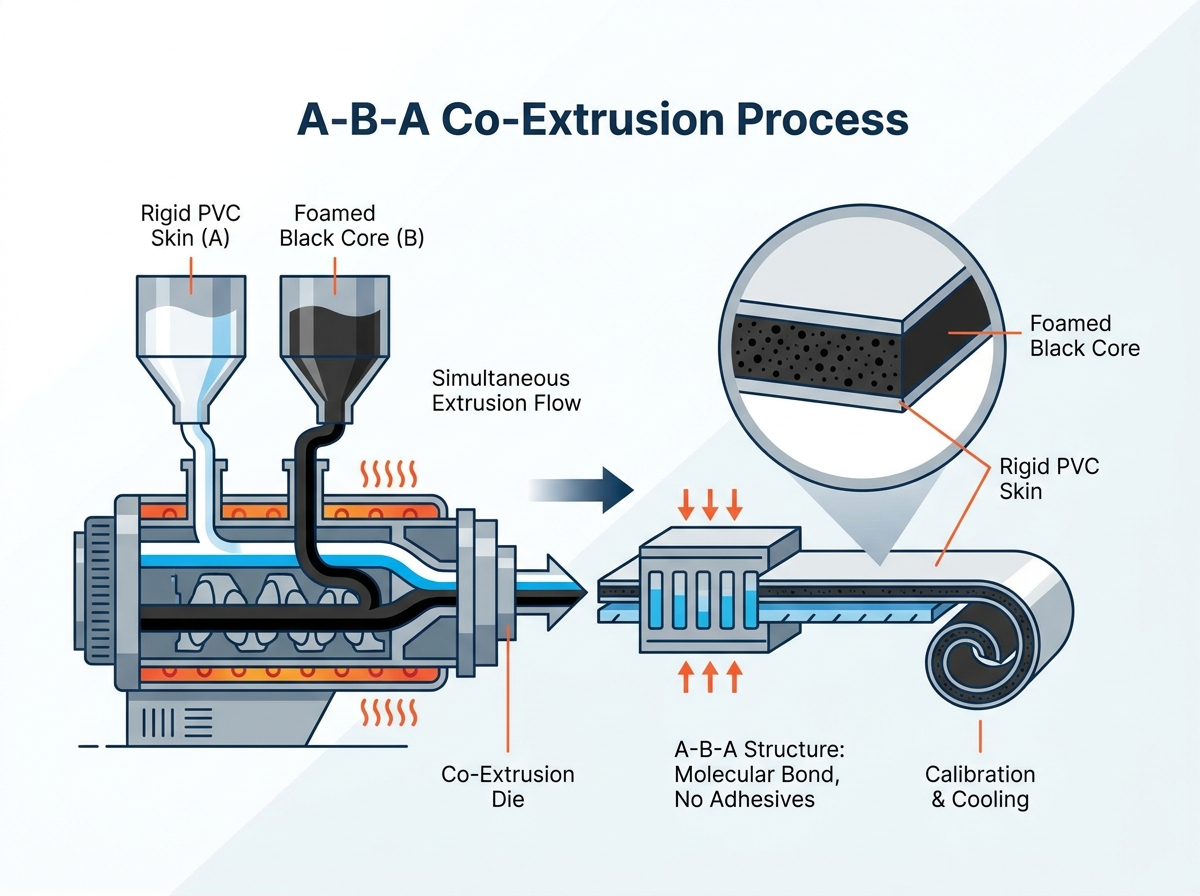
Engineers refer to this specific configuration as an "A-B-A" structure. The "A" layers represent the rigid, impact-resistant outer PVC skins. These outer skins encapsulate the board, providing a smooth and hard surface. The "B" layer represents the foamed black core hidden inside. This core provides volume and thickness without adding excessive weight. Together, they create a composite panel acting as a single cohesive unit.
Traditional lamination relies heavily on applied adhesives or edge-banding. Manufacturers press a solid skin onto a core material using industrial glues. Adhesives introduce a massive point of failure. When you expose laminated boards to high heat or freezing weather, the glue often becomes brittle or melts. Moisture creeps in, causing the layers to peel or blister.
Co-extrusion eliminates this entirely. We melt the core and the skin materials simultaneously. They meet inside a specialized die while still in a molten state. The polymers cross-link at a molecular level. Once cooled, you cannot separate the skin from the core. Molecular bonding ensures the board remains intact under severe temperature fluctuations.
Best Practice: Always specify co-extruded boards over laminated alternatives for wet or outdoor environments.
Common Mistake: Assuming standard edge-banded boards will survive seasonal weather changes without peeling.
You might wonder why we specifically formulate a black core. The color serves essential engineering and aesthetic purposes. We integrate carbon black into the PVC mix. Carbon black acts as a powerful UV absorber. It protects the polymer chains from solar degradation.
A black core also provides enhanced thermal dimensional stability. Dark pigments absorb heat uniformly, reducing localized warping stresses. Aesthetically, the black core offers distinct advantages. If a heavy impact scratches the outer colored skin, the dark core visually masks the damage. When operators route the edges using CNC machines, the exposed black core presents a clean, professional finish requiring no secondary painting.
Creating this material requires immense precision. The process moves from raw powder to a finished, dimensionally stable panel through four distinct stages.
Stage 1: Raw Material Formulation and Mixing
The skin and the core require entirely different chemical formulations. Operators mix PVC resins, foaming agents, carbon black, and UV stabilizers for the core. The skin formulation omits the foaming agents to remain rigid. We blend these materials in high-speed mixers under strict temperature controls. Precise mixing ensures the foaming agents activate at the exact right moment later in the process.
Stage 2: Dual-Screw Simultaneous Extrusion
This stage involves feeding the two distinct PVC blends into separate hoppers. Two parallel extruder machines heat and pressurize the materials. A dual-screw mechanism pushes the molten plastics toward a single, highly specialized co-extrusion die. Inside this die, the two melts converge. The core material expands as the foaming agents release gas. Meanwhile, the outer skin material wraps around the expanding core, remaining solid and dense.
Stage 3: Calibration and Vacuum Cooling
The hot, newly formed board exits the die and immediately enters a calibration block. This machine acts as a highly precise mold. Vacuum pumps pull the hot skin tightly against the calibrator walls. Chilled water circulates through the block to cool the plastic rapidly. Controlled cooling locks in the final dimensions. It maintains surface flatness and prevents the internal core stresses from warping the board.
Stage 4: Automated Pulling, Cutting, and QA
A continuous pulling machine grips the cooled board. It draws the panel down the line at a highly regulated speed. Continuous tension control prevents unwanted thickness variations. If the puller moves too fast, the board thins out. Next, an automated saw cuts the continuous sheet into custom lengths. Quality assurance sensors monitor the board thickness in real time before stacking.
You must evaluate the surface hardness of the outer skin. Industry professionals measure this using the Shore D hardness scale. A well-manufactured co-extruded board typically scores between 65 and 70 Shore D. This metric means the board will resist denting and scratching far better than standard celuka or free-foam PVC.
If the surface feels spongy or scratches easily with a fingernail, the manufacturer likely ran the extruder too quickly. A poor finish compromises ink adhesion for printing and reduces overall weatherability.
Inspect the cross-section closely. The black core must show a uniform, micro-cellular structure. It should look like tightly packed, tiny bubbles. You should never see large voids, hollow cavities, or inconsistent bubble sizes.
Large bubbles indicate poor temperature control during extrusion. These voids create brittle sections inside the board. Brittle cores compromise screw-holding strength. If a fabricator drives a fastener into a void, the screw will spin out and fail to grip.
Precision manufacturing yields strict dimensional tolerances. Thickness consistency remains the most critical factor for automated CNC routing. Industry-standard expectations demand a thickness variation of no more than ±0.2mm to ±0.5mm, depending on the total board thickness.
Diagonal squareness also matters. A high-quality supplier guarantees panels cut perfectly square. Boards cut out of square force fabricators to waste time trimming edges before installation.
Plastics expand and contract with temperature changes. Quality manufacturing accounts for the Coefficient of Linear Thermal Expansion (CLTE). Proper formulation ensures the board performs reliably in outdoor or high-heat environments. High-quality boards expand predictably, allowing installers to calculate necessary expansion gaps accurately.
Here is a baseline comparison matrix for quality evaluation.
Quality Metric | High-Quality Manufacturing Standard | Signs of Poor Manufacturing |
|---|---|---|
Shore D Hardness | 65 to 70 (Highly scratch resistant) | Below 60 (Dents easily under pressure) |
Core Structure | Micro-cellular, tightly packed bubbles | Large visible voids, brittle texture |
Thickness Tolerance | ±0.2mm to ±0.5mm variance | Over ±1.0mm variance (uneven surface) |
Delamination Risk | Zero (Molecularly bonded layers) | Peeling edges or blistering skin |
Manufacturers can produce custom-colored skins over a standard black core. This capability provides massive design flexibility. We match architectural brand colors by adjusting the pigment loads in the rigid outer layer.
Achieving perfect color requires strict technical control. The manufacturer must verify pigment colorfastness and UV stability. If they use cheap colorants, the outer skin will fade rapidly under sunlight. The pigment must also bond seamlessly with the base PVC resin without altering the material's impact resistance.
The typical manufacturing range for these boards spans from 5mm up to 30mm. Producing standard thicknesses within this range runs smoothly on standard dies. However, ultra-thick or ultra-thin boards present engineering challenges.
Extruding a 30mm board requires massive cooling capacity to prevent center-core warping. Extruding a 5mm board requires precise die lip adjustments to ensure the skin remains proportionate to the core. Pushing boundaries outside this standard range demands specialized, expensive tooling.
Custom requests impact Minimum Order Quantities (MOQs). When a buyer requests a non-standard skin color or a custom extrusion width, the factory must halt the line. They must purge the extruder barrels of the previous color.
Purging incurs unavoidable raw material waste. The manufacturer must run the machine until the new color extrudes perfectly. Because of this necessary waste, suppliers enforce higher MOQs for custom colors to offset the material loss. Expect longer lead times as factories schedule these specialized runs around standard production.
Do not source materials based on visual inspection alone. Advise your procurement team to request comprehensive Technical Data Sheets (TDS). A reliable TDS provides hard engineering data.
Look specifically for screw pull strength metrics. This number tells you how well the core holds mechanical fasteners. Review the flexural modulus to understand panel stiffness. Finally, check the water absorption rates. Even though PVC resists water, a poorly manufactured foamed core can trap moisture if exposed at the edges.
The hardware inside the factory matters immensely. Ask potential suppliers about the age and brand of their co-extrusion dies. Equipment maintenance dictates product consistency.
Older, unmaintained dies often suffer from uneven internal pressure. This uneven pressure pushes more material to the center of the board and less to the edges. Consequently, you receive boards with uneven skin thickness. Modern, well-calibrated dies ensure perfectly flat panels from edge to edge.
Best Practice: Request photos of the factory floor or schedule a video tour to verify equipment standards.
Common Mistake: Choosing a supplier based solely on price without verifying their extrusion die maintenance schedule.
Before committing to a bulk order, you must test a physical sample. Do not assume the production run will match a pristine brochure. Use this short checklist for your testing protocol:
Route the edge: Run the board through a CNC router. A clean cut indicates excellent core density. Tearing or chipping indicates a weak core.
Measure skin thickness: Use digital calipers to measure the outer rigid skin. It should measure uniformly across different points.
Perform an impact test: Strike the surface with a blunt tool. The board should resist cracking, and the skin should remain securely bonded to the black core.
If you need guidance setting up these testing protocols for your specific application, feel free to contact us directly for technical support.
Understanding the internal co-extrusion process empowers you to make smarter purchasing decisions. You now know how molecular bonding eliminates delamination risks and why carbon black enhances environmental resilience. This knowledge helps you ask the right technical questions and avoid low-grade, laminated substitutes.
By evaluating core density, verifying dimensional tolerances, and demanding proper technical documentation, you protect your projects from material failure. Your next step involves moving from theory to practice. Request a physical material sample and a detailed specification sheet from your shortlisted manufacturer. Run these samples through your in-house CNC machines and finishing tests to guarantee they meet your exact structural requirements.
A: No. Because the manufacturing process utilizes simultaneous co-extrusion, the outer skin and the inner core fuse together while in a molten state. This creates a permanent molecular bond. Unlike laminated boards that rely on glues, there is no adhesive layer to dry out, freeze, or fail over time.
A: Yes. A high-quality board features a uniform, micro-cellular dense core. This tight cell structure machines beautifully under CNC routers. It ensures clean, smooth cuts without chipping or tearing. The density also provides excellent screw-holding strength, allowing for strong mechanical fastening.
A: Formulating a black core involves specialized carbon black pigments and specific UV stabilizers, which can marginally increase raw material formulation costs. However, this upfront processing investment significantly enhances outdoor durability and scratch masking, delivering higher long-term performance value.
A: The dual-layer extrusion process allows us to optimize UV protection perfectly. We load the rigid outer skin with titanium dioxide to reflect harsh sunlight. Simultaneously, the carbon black infused inside the core acts as an intense UV absorber. Together, they prevent the polymer chains from degrading outdoors.


