


Views: 0 Author: Site Editor Publish Time: 2026-08-10 Origin: Site


Panel fabrication faces a persistent design challenge. Hiding unsightly core materials requires extra steps and complicates production. Traditional edge banding adds labor, extends lead times, and introduces potential failure points. Glue lines degrade over time. Edges chip and peel under heavy use.
Enter a smarter substrate. We introduce black core PVC board not merely as a structural base, but as an intentional design choice. Exposing this dark core yields high-contrast architectural detail. You can route, chamfer, or leave the edges bare. The result looks deliberate and refined.
You must evaluate when to specify this material. We will explore why it outperforms standard MDF, plywood, or white-core PVC. Premium commercial and residential applications demand flawless aesthetics. Discover how eliminating edge treatments transforms your manufacturing process. Read on to master the tooling, applications, and design benefits of this unique board.
Eliminates Edge Banding: Exposed black cores offer a finished, modern aesthetic right off the CNC router, reducing secondary processing.
High-Contrast Design: Ideal for laminating with lighter face materials; V-grooving and engraving reveal a sharp, distinct black line.
Moisture & Rot Immunity: Outperforms wood-based cores in outdoor living, marine, and high-humidity environments.
Machining Realities: Requires specific tooling and feed rates to prevent friction melting, but yields clean, paint-free edges when processed correctly.
Traditional substrates create hidden bottlenecks in panel manufacturing. Plywood and Medium-Density Fiberboard (MDF) dominate the industry. However, they share a critical flaw. Their raw edges look unfinished and absorb environmental moisture. You must cover these edges to deliver a premium product.
Edge banding introduces a cascade of manufacturing hurdles. You need specialized machinery to apply the tape. You must source matching edge banding materials. The process demands structural adhesives and constant labor supervision. Over time, traditional edge treatments fail. Heat and humidity weaken the glue. The banding shrinks, peels, or chips. These failures compromise the entire installation. They lead to costly callbacks and frustrated clients.
Modern architecture embraces a different methodology. Designers now treat the core as a feature, not a flaw. Exposing a solid black core flips the narrative. The substrate cross-section becomes a deliberate architectural shadow line. It acts as a decorative border. This minimalist approach removes the weak link. You no longer pretend the core does not exist. You highlight it.
Fabricators and designers share specific success criteria for material selection. You need a material meeting three non-negotiable standards:
It must machine cleanly without fraying or chipping.
It must resist moisture natively, without chemical sealers.
It must require zero post-processing on the exposed edges.
Meeting these criteria streamlines your workflow. It allows you to produce intricate geometries. Curves and cutouts become simple. You bypass the nightmare of edge-banding complex custom shapes.
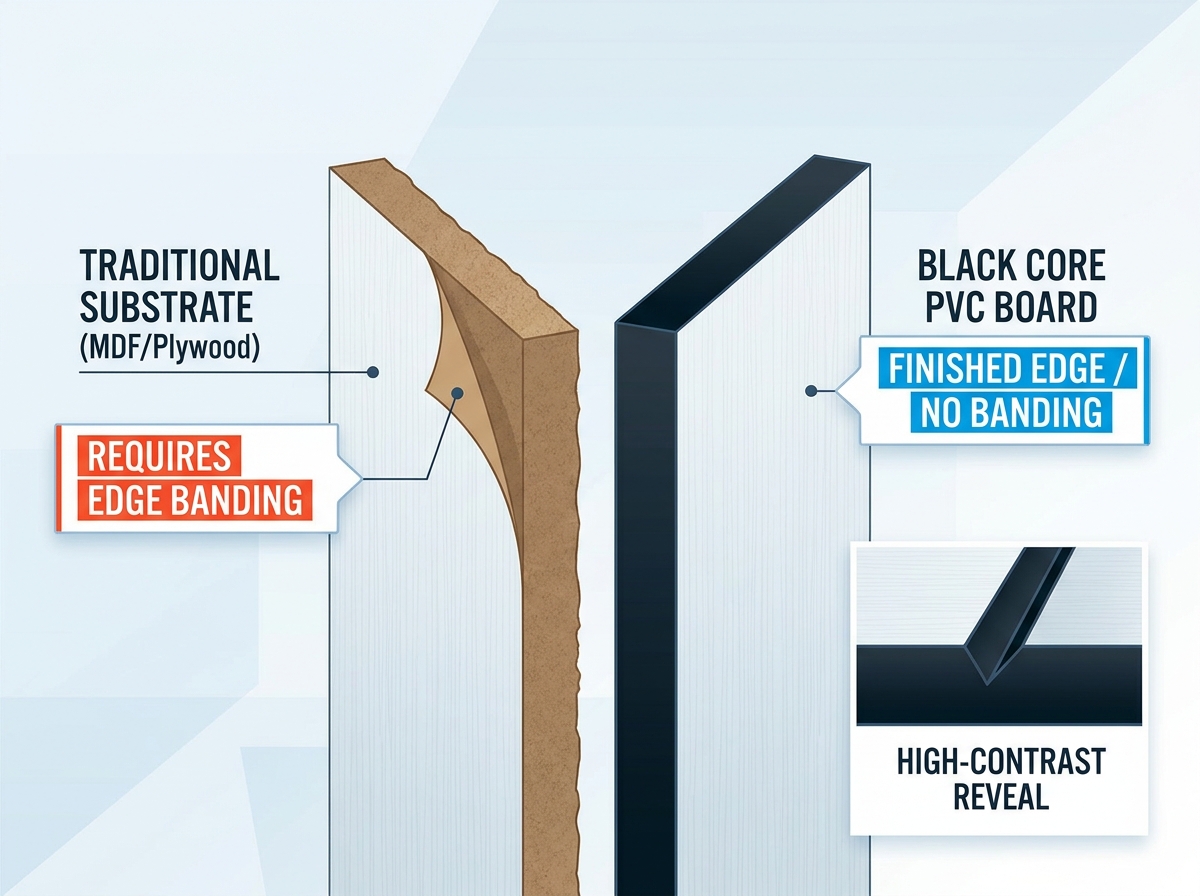
Designers specify materials based on visual impact and reliable performance. A dark core substrate delivers uniquely on both fronts. It pairs beautifully with high-pressure laminates (HPL). You can also bond colored PVC face sheets to it. Applying a bright white or vibrant colored face creates striking two-tone visuals. The dark edge frames the face color. This mimics the high-end look of phenolic resin panels.
Three-dimensional routing showcases the material perfectly. CNC routing and engraving unlock new creative avenues. When you use V-bits to carve into the surface, you expose the dark interior. The uniform density allows for highly intricate lettering. You can machine complex geometric patterns. Traditionally, you would need to paint these recessed areas. A dark core eliminates this step entirely. The sharp, distinct black line emerges naturally from the cutting pass.
Functionality matches the aesthetic appeal. We must highlight its closed-cell structure. Wood-based cores rely on open cellular networks. They draw in water through capillary action. This thermoplastic board behaves differently. It completely locks out moisture.
It does not swell when exposed to water. It will not rot or delaminate in damp environments. You can confidently leave the edge exposed. It remains functionally safe in kitchens, bathrooms, and exterior spaces. The structural integrity remains intact regardless of the local humidity.
Best Practices for Design: Use light-colored or woodgrain HPL faces. The extreme contrast maximizes the shadow-line effect on chamfered edges.
Common Mistakes: Avoid using dark faces if you want the edge to stand out. Lack of contrast hides the unique architectural detail of the core.
Selecting the right substrate requires a clear understanding of the alternatives. You must weigh aesthetics against physical performance. Let us examine how this material stacks up against common industry staples.
Standard white or grey PVC foam board serves utilitarian purposes well. However, it often falls short in high-end design. Standard boards look raw or unfinished when left exposed. White edges show dirt easily. In contrast, the dark variant provides a premium depth. It closely resembles expensive solid surface materials. The dark edge acts as a natural shadow, hiding dust and wear.
MDF and plywood offer excellent rigidity. Yet, they carry immense moisture absorption risks. You must meticulously seal every exposed edge. Any failure in the seal leads to catastrophic swelling. The dark thermoplastic core eliminates this risk entirely. You achieve total immunity to water damage. You eliminate the labor cost of edge sealing.
Solid surface and phenolic panels offer similar high-contrast aesthetics. They are highly durable. Unfortunately, they are incredibly heavy and notoriously expensive. Processing them requires specialized heavy-duty tooling. The dark foam board offers substantially lighter weight. It boasts a much lower material cost. This translates to a highly scalable Return on Investment (ROI) for large-format rollouts, such as retail store displays.
Substrate Type | Edge Finishing Required | Moisture Resistance | Weight Profile |
|---|---|---|---|
Black Core PVC | None (Ready off CNC) | Excellent (Closed-cell) | Light to Medium |
MDF / Plywood | High (Banding/Sealing) | Poor (Prone to swelling) | Medium to Heavy |
Standard White PVC | Low (Aesthetically limited) | Excellent | Light |
Phenolic Resin Panels | None (Polishing optional) | Excellent | Very Heavy |
Theoretical benefits mean little without practical execution. Fabricating thermoplastic requires an adjustment in your shop’s methodology. You cannot treat it exactly like wood.
CNC routing demands precise parameters. Friction constitutes your biggest enemy. Thermoplastics melt if the router bit generates excessive heat. You must optimize your feed rates and chip loads. We strongly recommend using single-flute O-flute bits. These bits clear chips rapidly. They prevent the chips from re-welding to the cut edge. Maintain a high feed rate while slightly lowering your spindle RPM. A clean cut yields a smooth, paint-free edge right off the machine.
You must acknowledge a critical physical property. Dark materials absorb solar heat. Thermal expansion requires careful planning. The board will expand and contract more than white PVC in direct sunlight. You must engineer your assemblies to accommodate this movement. Use oversized holes for mechanical fasteners. Leave appropriate expansion gaps between panel seams in outdoor applications.
Lamination demands specific chemical compatibilities. The closed-cell surface does not absorb glue like wood veneer does. You require specific structural adhesives to bond decorative skins securely. We recommend using specialized urethanes or industrial cyanoacrylates. Contact cements work well for HPL, provided you follow the manufacturer's flash-time instructions closely. Always test your adhesive on a scrap piece before running a full production batch.
Select the Right Tooling: Equip your CNC with sharp, up-cut single-flute O-flute bits.
Adjust Speeds: Keep RPM between 16,000 and 18,000. Push feed rates to ensure a large chip load.
Manage Heat: If edge melting occurs, increase your feed rate immediately.
Plan for Expansion: Calculate a 1/8-inch gap for every 4 feet of linear material in exterior setups.
Knowing how to cut the material is only half the battle. You must know where to deploy it. Certain sectors benefit immensely from its unique properties.
Commercial retail relies heavily on Point-of-Purchase (POP) displays. These environments experience high foot traffic. Displays must look modern and endure abuse. Retail rollouts also demand exceptionally fast fabrication times. Skipping the edge-banding station shaves days off a production schedule. The high-contrast edges grab consumer attention.
Outdoor living spaces and marine cabinetry represent another perfect match. Moisture destroys standard wood cabinetry rapidly. Marine environments feature high humidity and salt spray. Consumers still demand premium aesthetics in these spaces. They want the look of luxury indoor cabinets outdoors. The two-tone contrasting edges provide this luxury feel. The closed-cell thermoplastic guarantees decades of rot-free performance.
Architectural signage benefits significantly as well. Wayfinding signs and dimensional lettering require crisp, clean returns. Painting the sides of intricately cut letters wastes hours of labor. A solid dark substrate eliminates the need to paint these returns. You cut the letters, clean the dust, and mount them directly.
Your next-step actions require due diligence. We guide buyers to request physical samples first. You need to verify density tolerances. Look for a density range of 0.55 to 0.60 g/cm³. This specific density provides optimal edge finishing without crumbling. You must also conduct your own lamination trials. Test your preferred adhesive compatibility in your own shop environment.
Material selection defines the success of modern fabrication. You now understand how a dark core substrate bridges a crucial gap. It successfully merges utilitarian environmental performance with premium architectural design. You no longer have to sacrifice aesthetics for durability.
We present a clear final verdict. This material offers a remarkably high-ROI solution. It suits projects demanding absolute moisture resistance. It excels when you need zero edge-banding. It shines in high-contrast routing applications. The labor savings alone justify the switch for most commercial fabrication shops.
Take action on your next premium project. Encourage your specifiers and designers to rethink their standard substrate choices. Request a physical sample for CNC testing today. Run your own lamination trials to verify the bond strength. Feel free to contact us to discuss specific density requirements and secure material for your upcoming fabrication needs.
A: No sealing is required for moisture protection. A clean CNC cut leaves a smooth matte finish; it can be lightly sanded or flame-polished if a glossier edge is desired.
A: Yes. Applying HPL or acrylic films to the faces is common. The resulting exposed black edge creates a modern, distinct shadow line.
A: Black core PVC absorbs more UV heat, which can increase its rate of thermal expansion and contraction. Proper mechanical fastening and expansion gaps are necessary for exterior applications.
A: It depends on the thickness and span. While denser than standard foam board, it is a thermoplastic and may sag over long, unsupported spans under heavy weight compared to solid wood or steel.


